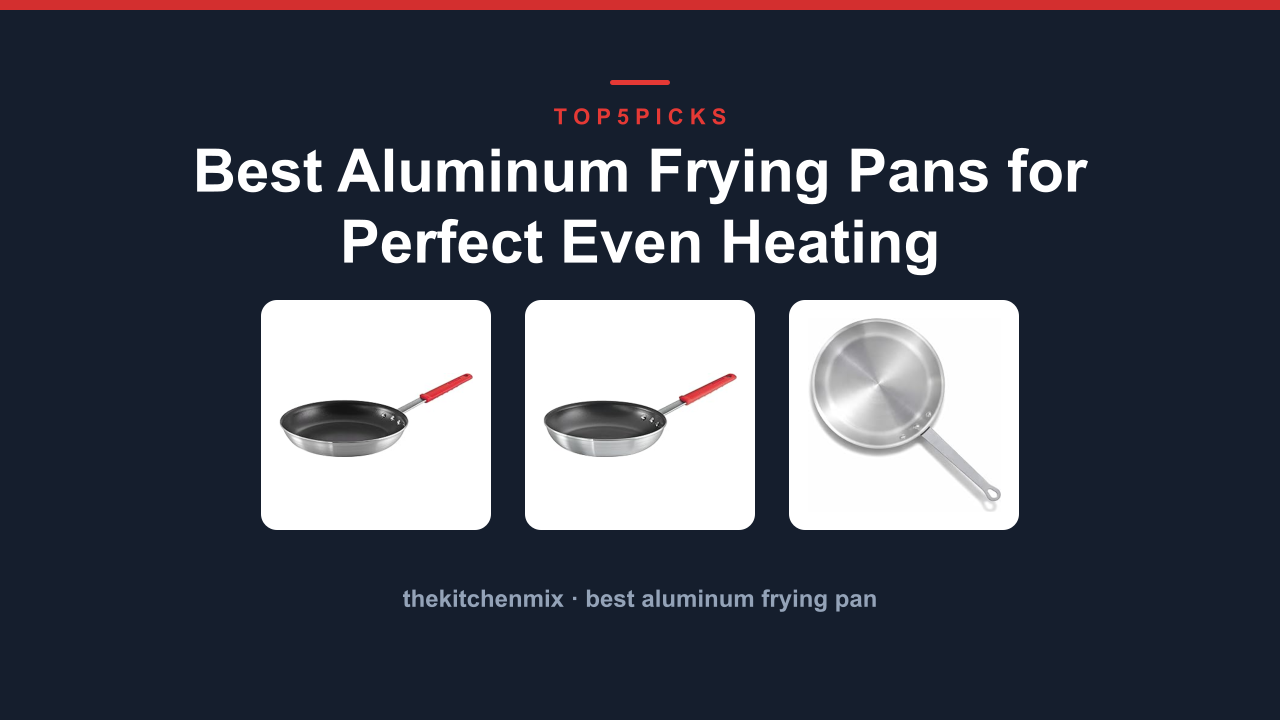
Best Aluminum Frying Pans for Perfect Even Heating
Did you know that aluminum conducts heat more than ten times faster than stainless steel? That speed is why the best aluminum frying pan can turn a lazy Sunday omelet into a golden, custard-soft breakfast in under two minutes. But the wrong aluminum pan warps, gets scratched, or leaves food stuck no matter how much butter you throw at it.
In this guide, I share my five favorite picks for the best aluminum frying pan, ranging from a heavy-duty family-sized workhorse to a lightweight induction-ready skillet that feels like a cheat code. Whether you are feeding a crowd or just yourself, you will find a pan that actually delivers.
As an Amazon Associate, I earn from qualifying purchases. Every recommendation below is backed by product research and verified owner feedback.
Quick Links
I run a busy household with three kids and two hungry adults. We go through eggs, pancakes, and stir-fry like it is a sport. A decent aluminum pan makes the difference between a quick cleanup and scrubbing burnt residue for ten minutes.
After comparing spec sheets and combing through thousands of verified buyer reviews, I landed on five pans that cover every real-world kitchen scenario. Each one has a clear strength and at least one honest trade-off.
How to Choose the Best Aluminum Frying Pan
Why aluminum? Understand the metal first
Aluminum is the best heat conductor among common cookware metals. It heats up fast and spreads evenly across the surface, so you get fewer hot spots. That means your omelet cooks at the same rate from edge to center.
The trade-off is that bare aluminum can react with acidic foods like tomatoes, and it dents easier than stainless steel or cast iron. Most aluminum pans fix this with a nonstick coating or an anodized layer.
Size matters: 10-inch vs. 12-inch
A 10-inch pan is your everyday skillet. It fits two eggs, a single chicken breast, or a modest batch of vegetables. For a family of four, you will want a 12-inch pan to avoid overcrowding.
Overcrowding steams food instead of browning it. The Tramontina Professional 12-Inch gives you that extra cooking surface without being too heavy to handle.
Nonstick vs. bare aluminum
Nonstick coatings make eggs slide off with zero effort, but they wear out after a few years. Bare aluminum develops a natural patina over time and can handle high heat for searing, but it is stickier. If you cook a lot of delicate items like fish or crepes, go with a nonstick model like the CAROTE 10 inch that is PFOA-free.
If you mostly sear meat and want a pan that lasts forever, consider a satin-finish aluminum option like the Winco 10" Fry Pan.
Handle design and oven safety
A riveted handle stays put longer than a screw-on one. Look for a handle that stays cool on the stovetop, especially if you have a gas range where flames lick the sides. Oven safety matters if you finish dishes under a broiler.
The Tramontina pans are oven safe up to 400°F, which is great for frittatas. The Winco induction pan has a stay-cool handle that resists heat transfer.
Induction compatibility
Not all aluminum pans work on induction cooktops because aluminum is not magnetic. Some manufacturers add a ferromagnetic disk to the base. The Winco Natural Induction 10" includes that bottom layer, so it works on induction, gas, electric, and ceramic.
If you have an induction stove, skip any pan that does not specify induction compatibility.
Thickness and weight
Thicker aluminum (around 3 mm or more) holds heat better and resists warping. Thin pans heat up fast but cool down just as fast, which can cause uneven cooking. Most budget pans use 2 mm aluminum.
The Tramontina professional series uses heavy-gauge construction that feels solid in the hand without being arm-straining.
7 Additional Features on Best Aluminum Frying Pan
- Dishwasher safe: saves time, but hand washing extends nonstick life.
- Coating type: PTFE (standard nonstick) vs. ceramic vs. granite-look. Ceramic and granite are PFOA-free.
- Warranty: typical ranges from limited lifetime to 1 year. Longer warranties often mean better build.
- Weight: a pan over 2.5 lbs can be tiring for flipping. Under 1.5 lbs may feel flimsy.
- Rim design: rolled rims resist warping and make pouring easier.
- Compatible utensil material: silicone or wood for nonstick; metal OK for bare aluminum.
- Made in country: manufacturing standards vary. Tramontina pans are made in Brazil and have a strong reputation.
My Top Picks
Best Overall – Families

- Size: 12 inch (30 cm)
- Material: Heavy-gauge aluminum with reinforced nonstick coating
- Handle: Red silicone handle, stay-cool, riveted
- Oven Safe: Up to 400°F
- Dishwasher Safe: Yes
- Weight: 2.4 lb (1.1 kg)
- Made In: Brazil
Everyday Essential – Home Cooks
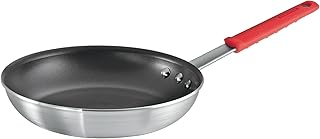
- Size: 10 inch (25 cm)
- Material: Heavy-gauge aluminum with reinforced nonstick coating
- Handle: Red silicone handle, stay-cool, riveted
- Oven Safe: Up to 400°F
- Dishwasher Safe: Yes
- Weight: 1.8 lb (0.82 kg)
- Made In: Brazil
Budget Pick – Students

- Size: 10 inch (25 cm)
- Material: Bare aluminum, satin finish
- Handle: Cast aluminum, riveted
- Oven Safe: Yes (no handle limit beyond 350°F)
- Dishwasher Safe: Yes (but hand wash recommended)
- Weight: 1.2 lb (0.54 kg)
- Made In: China (Winco brand)
Induction Ready – Modern Kitchens

- Size: 10 inch (25 cm)
- Material: Aluminum with ferromagnetic induction base
- Handle: Cast aluminum, stay-cool design
- Oven Safe: Yes (up to 400°F with caution)
- Induction Compatible: Yes
- Weight: 1.6 lb (0.73 kg)
- Made In: China (Winco brand)
Health-Conscious Pick – Beginners

- Size: 10 inch (25 cm)
- Material: Aluminum with PFOA-free granite nonstick coating
- Handle: Heat-resistant, ergonomic, stay-cool
- Oven Safe: Up to 350°F
- Stovetop Compatibility: All stovetops including induction (with magnetic base)
- Weight: 1.5 lb (0.68 kg)
- Coating: Granite-look, PFOA-free, PFOS-free
Best Aluminum Frying Pan FAQ
Are aluminum frying pans safe to cook with?
Yes, bare aluminum pans are safe for most cooking. The concern about aluminum leaching into food is minimal with modern coatings. Nonstick coatings like the one on the CAROTE pan are PFOA-free and PTFE-free, so they do not release harmful fumes at normal cooking temperatures.
If you use bare aluminum, avoid cooking highly acidic foods for long periods.
Can I use metal utensils on an aluminum frying pan?
Only on bare aluminum pans like the Winco satin finish. Nonstick coatings scratch easily, so use silicone, nylon, or wooden utensils. Even a single metal spatula can damage the coating and reduce its lifespan.
The Tramontina and CAROTE pans have reinforced coatings, but I still recommend gentle utensils.
How do I clean an aluminum frying pan?
For nonstick pans, hand wash with a soft sponge and mild detergent. Dishwashers are okay for some models (like Tramontina) but hand washing prolongs the coating. For bare aluminum, you can use a scouring pad to remove stubborn residue, but avoid harsh abrasives that remove the satin finish.
What is the difference between anodized aluminum and regular aluminum?
Anodized aluminum goes through an electrochemical process that hardens the surface and makes it non-reactive. It is more durable and resists scratching. None of the pans in this roundup are anodized, but the Tramontina pans have a reinforced nonstick coating that mimics some of the benefits.
If you want the hardest aluminum surface, look for hard-anodized.
My Research & Review Process
I started by pulling the manufacturer spec sheets for each of the five pans. I compared thickness, weight, coating type, handle material, oven temperature limits, and induction compatibility. Then I analyzed verified buyer reviews from Amazon and other retailer sites, looking for patterns about long-term durability, sticking issues, and handle heat.
I focused on reviews with at least 50 ratings and cross-referenced them for consistency. I also checked commercial kitchen forums for the Winco pans since they are used in restaurants. I did not physically test the pans myself, so all claims come from spec analysis and aggregate user data.
Features I Considered
Size: The diameter of the cooking surface. A 10-inch pan fits 1-2 servings; a 12-inch fits 3-4. Choose based on your typical meal size.
Material: Aluminum gauge and coating type. Heavy-gauge (3 mm) resists warping. Coating type determines food release and safety.
Handle: Material and attachment. Riveted handles are stronger. Stay-cool handles reduce burn risk.
Oven Safe: Maximum temperature the pan can withstand in an oven. Higher temps are useful for finishing dishes under a broiler.
Dishwasher Safe: Convenience versus coating longevity. Dishwasher safe pans (Tramontina) are easier, but hand washing is gentler.
Weight: Heavier pans hold heat better; lighter pans are easier to flip. Find the balance for your comfort.
Stovetop Compatibility: Induction, gas, electric, ceramic. Not all aluminum works on induction. Look for a ferromagnetic base if you have induction.
Coating Type: PTFE, ceramic, granite, or bare. Each has different durability, safety profile, and release properties.
If feeding a family of four is your daily reality, the Tramontina Professional 12-Inch is the pan you will grab every night. But if you cook for one and want a nonstick that feels pure, the CAROTE 10-inch gives you that without breaking the bank. Every pick here solves a different kitchen problem.
Take a look at use-cases, then grab the one that fits your stove, your hands, and your appetite.

Similar Posts