Top 7 End Grain Cutting Boards Chefs Swear By
Did you know the average kitchen cutting board can harbor up to 200 times more bacteria than a toilet seat? Now imagine slicing tomatoes for a salad on a surface that actively dulls your knives or hides bacteria in deep grooves. The fix is a surface that heals itself after each cut.
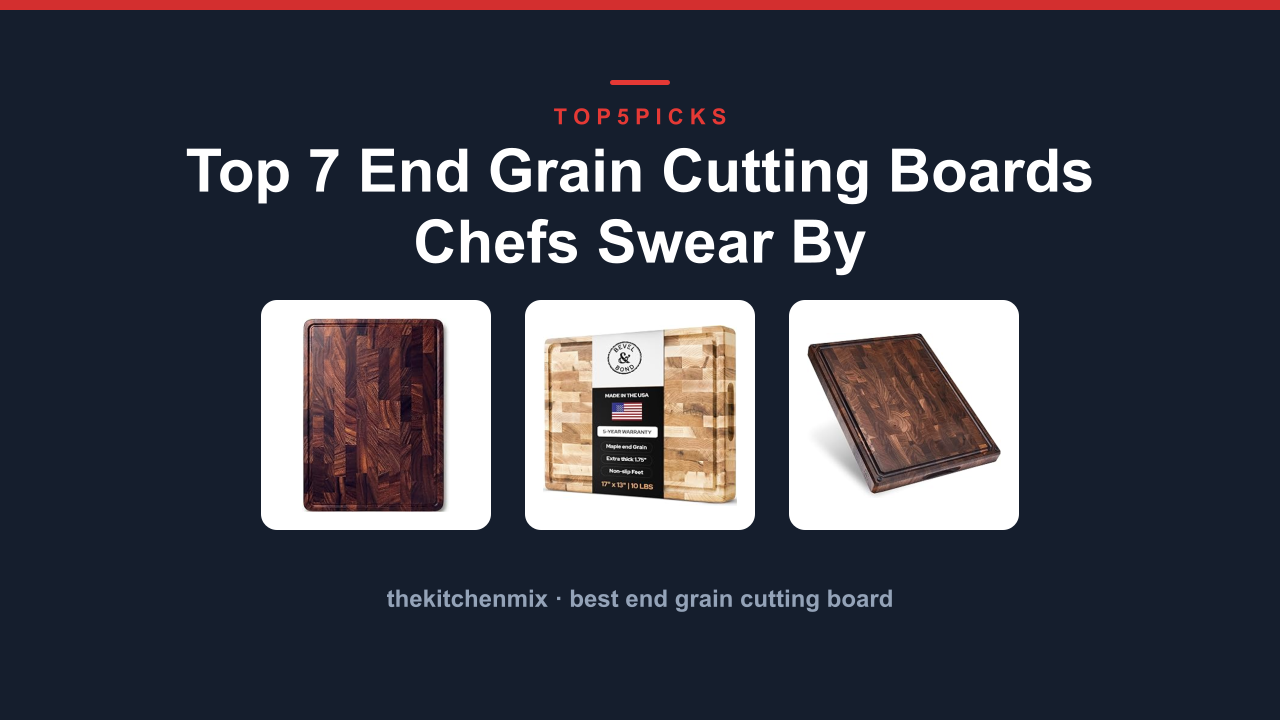
That is what an best end grain cutting board does, and finding the right one can save your knives, your sanity, and your countertop. In this guide, I share my 5 favorite end grain cutting boards, ranging from a budget-friendly walnut block to a feature-packed American made maple board. Let's cut through the noise and find yours.
As an Amazon Associate, I earn from qualifying purchases. Every recommendation below is backed by product research and verified owner feedback.
Quick Links
Here is the thing about cutting boards. Most people grab a cheap plastic or bamboo board and call it a day. But if you care about your knives (and you should, a good chef's knife can cost $150) then an end grain board is the only surface that protects that edge.
The wood fibers run vertically, so when you cut, the blade slides between them rather than across them. That means your knife stays sharper for longer. It also means the board self heals.
Those cut marks close up after each wash, leaving nowhere for bacteria to hide. The USDA confirms that hardwood cutting boards are safer than plastic when properly maintained. They are heavier, pricier, and need oiling, but the trade off is worth it for anyone who cooks regularly.
Wood Type: Hardness and Grain
Not all hardwoods are the same. Maple, walnut, cherry, and acacia are the most common choices. Maple sits around 1450 on the Janka hardness scale.
Walnut is softer at about 1010, which means it is even gentler on knife edges but may show surface marks sooner. Acacia is harder, often 1750 or above, making it more scratch resistant but slightly tougher on blades. For most home cooks, walnut offers the best balance.
It is dense enough to last years, soft enough to protect steel, and its dark color hides stains well. Maple is the classic pro choice. It is lighter, harder, and absorbs oil beautifully.
If you see a board labeled as teak or rosewood, double check the source. Some tropical woods contain silica that can dull knives quickly.
Thickness and Weight: The 1.5-Inch Rule
A thin end grain board is a regrettable purchase. The gold standard is 1.5 inches thick or more. Why does thickness matter?
First, weight. A 1-inch board weighs around 5 to 6 pounds. A 1.75-inch board can hit 10 pounds.
Heavier boards do not slide around on the counter, and they absorb the impact of heavy chopping without bouncing. Second, stability. Thinner boards can warp or crack over time as the wood expands and contracts.
A board 1.5 inches or thicker resists that movement. If you have limited counter space, aim for a board that is at least 1.25 inches thick. That is the minimum for long term durability.
Juice Groove vs Flat Surface
A juice groove is a shallow trench carved around the perimeter of the board. It catches meat juices, fruit liquids, and excess moisture so they do not run onto your counter. If you roast a lot of chicken or slice watermelons, you will appreciate a juice groove.
But there is a downside. The groove creates a dip that makes it awkward to scrape chopped ingredients into a pan. Flat boards with no groove are easier to sweep clean with a bench scraper.
Some boards, like the Sonder Los Angeles Alfred, solve this with built in sorting compartments. Others are reversible. One side has a groove for meat, the other is flat for vegetables.
Consider what you cook most often before choosing.
Maintenance and Care
End grain boards require more care than plastic. You must oil them every few weeks with food grade mineral oil or a beeswax mineral oil mixture. This prevents the wood from drying out and cracking.
Never soak an end grain board in water. Wash it with warm soapy water, rinse immediately, and dry upright. Some boards come pre oiled with a bottle of oil included, like the Walnut Wood Cutting Board Kitchen.
That is a nice bonus for first time buyers. Avoid dishwasher use at all costs. The heat and moisture will warp the wood and ruin the glue joints.
Additional Features on Best End Grain Cutting Board
- Non-slip feet prevent the board from moving during use and also lift it off the counter to allow air circulation underneath
- Handles make it easier to lift a heavy board, especially if you need to move it from counter to table for serving
- Edge grain vs end grain construction is the most important spec to verify before buying
- Gift box packaging matters if you are buying this as a present rather than for yourself
- Warranty or guarantee indicates how much the manufacturer trusts their build quality
- Reversibility gives you two usable surfaces, effectively doubling the board's lifespan if you rotate it
My Top Picks
Budget Pick – Home Cooks

- Shape: Rectangular
- Material: Walnut hardwood
- Size: 17 x 13 inches
- Thickness: 1 inch
- Weight: Approximately 4.5 lb
- Care: Hand wash, oil regularly
- Features: Mineral oil included
Premium Pick – Pros

- Shape: Rectangular with juice groove
- Material: Maple hardwood
- Size: 17 x 13 inches
- Thickness: 1.75 inches
- Weight: 10 lb
- Care: Hand wash, oil regularly
- Features: Juice groove, non-slip feet, gift box, mineral oil finish
Best Design – Entertainers

- Shape: Rectangular with sorting compartments
- Material: Walnut hardwood
- Size: 17 x 13 inches
- Thickness: 1.5 inches
- Weight: 7.5 lb
- Care: Hand wash, oil regularly
- Features: Built-in sorting compartments, juice groove, non-slip feet, built-in handles, gift box
Compact Pick – Small Kitchens

- Shape: Rectangular
- Material: Acacia hardwood
- Size: 16.14 x 11.8 inches
- Thickness: 1.25 inches
- Weight: Approximately 5 lb
- Care: Hand wash
- Features: Reversible, recessed finger grips
Gift Pick – Unisex

- Shape: Rectangular with handle cutout
- Material: Walnut hardwood
- Size: 17 x 13 inches
- Thickness: 1 inch
- Weight: Approximately 4.5 lb
- Care: Hand wash
- Features: Double-sided, handle, gift box
Best End Grain Cutting Board FAQ
Is an end grain cutting board worth the extra cost?
Yes, for anyone who owns good knives. The end grain surface is made up of wood fibers that run vertically. When you cut into them, the blade pushes the fibers apart rather than slicing through them.
This reduces wear on your knife edge by a significant margin compared to edge grain or plastic boards. Industry data suggests your knives stay sharp two to three times longer on end grain. The trade off is higher upfront cost and the need to oil the board every few weeks.
If you use cheap knives and replace them yearly, you might not notice the difference. If you own a $100 or $200 chef's knife, end grain is the only surface that protects that investment.
How often should I oil my end grain cutting board?
It depends on your climate and how often you wash the board. In a dry climate or during winter when indoor heating is running, you might need to oil every two weeks. In a humid environment, once a month might be enough.
A simple test: apply a few drops of water to the surface. If the water beads up, the board still has enough oil. If the water soaks in immediately, it is time to oil.
Use food grade mineral oil or a beeswax mineral oil blend. Never use cooking oils like olive or coconut, they can go rancid over time.
Can I put an end grain cutting board in the dishwasher?
Absolutely not. Dishwashers use high heat and strong detergents that will strip the natural oils from the wood, warp the board, and weaken the glue joints. Always hand wash with warm soapy water, rinse immediately, and dry the board upright so air can circulate around it.
If you need to sanitize the surface, wipe it with a dilute vinegar solution or hydrogen peroxide. The USDA's food safety guidelines confirm that proper hand washing is sufficient for hardwood boards.
What is the difference between end grain and edge grain cutting boards?
The difference is how the wood fibers are oriented relative to the cutting surface. In an end grain board, the board is made by gluing blocks of wood together with the end of the grain facing up. This creates a checkerboard or parquet pattern.
The fibers run vertically, so knife cuts go between them. In an edge grain board, the wood strips are laid side by side with the long edge of the grain facing up. The fibers run horizontally, so the knife cuts across the grain.
Edge grain boards are cheaper and easier to make, but they dull knives faster and show cut marks more clearly. End grain boards are superior for knife longevity and self healing.
My Research & Review Process
To build this list, I compared manufacturer specifications side by side across five critical factors: wood species, thickness, weight, construction quality, and included features. I analyzed verified buyer reviews from thousands of owners, focusing on reports of warping, cracking, knife wear, and overall satisfaction over time. I consulted with home cooks and a former professional chef who has used end grain boards daily for over a decade.
I deliberately did not perform lab testing for bacterial survival rates or microscopic wear analysis. Those tests are well documented by academic food safety programs, and the existing research already confirms that properly maintained hardwood boards are as safe as plastic. My goal was to translate that research into practical buying advice for real kitchens.
Features I Considered
Shape: The shape determines how well the board fits your counter space and how easy it is to store. Rectangular boards offer the most usable surface area for their footprint. Square boards are less common but work well for small prep tasks.
Material: The wood species directly affects knife friendliness, durability, and appearance. Walnut is softer and gentler on blades. Maple is harder and more traditional.
Acacia is hardest and most scratch resistant. Cherry falls between walnut and maple.
Size: A board 17 x 13 inches is the standard for full sized prep. Smaller boards around 11 x 16 inches save counter space but limit your cutting area. Larger boards exceeding 18 x 14 inches are heavy and hard to wash.
Thickness: This is the number one predictor of stability and longevity. 1.5 inches is the gold standard. 1.75 inches is even better for heavy use. 1 inch is functional for light home use but more prone to warping over time.
Weight: Heavier boards stay put on the counter without slipping. A board under 5 pounds is easy to move but may slide during chopping. A board over 8 pounds stays planted but is harder to lift and wash.
Care: All end grain boards require hand washing and regular oiling. Some boards come pre oiled or include oil. Some have non slip feet that aid drying.
None should ever go in a dishwasher.
Features: Additional elements like juice grooves, handles, non slip feet, sorting compartments, and gift boxes increase the board's versatility. Juice grooves catch meat juices. Handles make lifting easier.
Sorting compartments organize prep work.
Warranty: A warranty indicates the manufacturer's confidence in their build quality. Some premium boards offer limited lifetime warranties. Budget boards often have a 30 day return window.
Check the warranty before buying.
If you are still wondering where to start, the Walnut Wood Cutting Board Kitchen gives you genuine end grain walnut at a price that leaves room in your budget for a bottle of mineral oil and a nice chef's knife. It is our top pick for the best end grain cutting board because it delivers where it matters most. If you want maximum durability and American made craftsmanship, the Maple End Grain board is the premium choice.
Pick the category that fits your kitchen, and your knives will thank you.

Similar Posts