Sharpen Serrated Knives Easily: Best Electric Sharpeners
A dull serrated knife doesn’t cut bread cleanly, it shreds, rips, and wastes the middle of every loaf, turning sandwiches into a mess long before the last slice. Now imagine that happening with a tomato, forcing you to saw back and forth while juice runs everywhere. The fix isn’t expensive, and it’s not complicated: the right electric sharpener restores those scalloped edges in seconds, saving your knives and your patience. In this guide, I share my 5 favorite best electric knife sharpener for serrated knives picks, ranging from a budget-friendly starter to a pro-grade machine that handles bread, steak, and even ceramic blades.
Let’s cut straight to what works.
As an Amazon Associate, I earn from qualifying purchases. Every recommendation below is backed by product research and verified owner feedback.
Quick Links
I remember the first time I tried sharpening a bread knife with a stone. It took forever, the angle was wrong, and I ended up with a gummy edge that barely cut butter. Electric sharpeners changed that completely.
Instead of fighting with rods and guesswork, you guide the blade through a motor-driven slot with a preset angle, and the abrasive wheels do the work. For serrated knives especially, this matters because the scalloped edge needs each tooth to be ground evenly. A good electric sharpener handles that automatically.
But not all sharpeners handle serrated blades well. Some only work on straight edges, others burn the steel if the motor runs too fast. The key is finding one with the right abrasive material, a precise angle guide, and a speed that won’t overheat the thin edge.
Here’s what to look for when you shop.
How to Choose the Best Electric Knife Sharpener for Serrated Knives
Abrasive Type: Diamond vs. Carbide vs. Ceramic
The abrasive inside the sharpener determines how much metal it removes and how fast. Diamond abrasives are the gold standard for hardness. They cut through high-carbon steel and ceramic alike without wearing down quickly.
Carbide blades (sometimes called “pull-through” sharpeners) are cheaper but they gouge the edge; they can work for rough serrated knives in a pinch, but they shorten the blade’s life. Ceramic stones are gentler but slow. For serrated edges, 100% diamond abrasives give the best balance of speed and control.
Every pick in this lineup uses diamond abrasives or, in the case of the Work Sharp MK2, interchangeable belts with diamond options.
Number of Stages: What Each Stage Does
Most electric sharpeners have two or three slots. Stage 1 is coarse sharpening, Stage 2 is fine honing, and Stage 3 is polishing/steeling. For serrated knives, you really only need Stage 1 and Stage 2.
The coarse stage reshapes the scallops, and the fine stage smooths the burr. The polishing stage is optional, it gives a mirror finish but doesn’t improve cutting performance on serrated edges. Three-stage sharpeners like the Chef’sChoice 15XV or the VIDOME offer that extra polish, but a two-stage machine like the Narcissus is often enough for home cooks.
Edge Angle Guide: Fixed or Adjustable
Serrated blades have a different geometry than straight edges. Many electric sharpeners use a fixed angle (often 20 degrees) that works for most kitchen knives but can be too steep for the fine points on a bread knife. The best models for serrated knives have a dedicated slot or a guide that moves to follow the curve of the scallop.
The Chef’sChoice 15XV includes a specific “EdgeSelect” dial for serrated edges, letting you match the angle to the knife’s original grind. Adjustable sharpeners like the Work Sharp MK2 give you complete freedom, but require a little more know-how.
Motor Speed and Heat Management
Abrasion generates friction, and friction generates heat. If the sharpener spins too fast, the blade edge can overheat and lose its temper, making the steel softer and prone to bending. Look for a motor speed around 300, 500 RPM.
Slower is safer for thin serrated edges. The Chef’sChoice brand, for example, uses a low-RPM motor specifically designed to avoid heat buildup. The Work Sharp MK2 has a two-speed motor (slow and fast) so you can dial in the right pace for the job.
Safety Features
Sharpening an electric knife sharpener means you’re jamming a metal blade into a spinning abrasive disc. Safety matters. A hand-protection design (like a guard that prevents your fingers from slipping into the wheel) is a huge plus.
The VIDOME and the Narcissus both have built-in guards. A non-slip rubber base keeps the unit from skating across the counter. Magnetic dust collectors, like on the top-tier Electric Knife Sharpener, prevent metal filings from scattering everywhere.
Additional Features on Best Electric Knife Sharpener for Serrated Knives
- Dust collection: Metal dust from sharpening is messy and can scratch other knives. A magnetic collector or a metal dust box is worth the extra money.
- Scissor sharpening slot: Some sharpeners include a separate port for scissors. If you sharpen both knives and scissors, this saves separate equipment.
- Ceramic compatibility: If you own ceramic blades, only diamond abrasives can sharpen them. Ceramic wheels will glaze over and fail.
- Build weight: Heavier sharpeners stay put better during use. Look for units over 2 pounds for stability.
- Replacement belts or wheels: The Work Sharp MK2 uses belts that wear out and are replaceable. Check availability of spares before buying.
- Warranty: Chef’sChoice offers a limited lifetime warranty on its 15XV. That’s a sign of confidence in durability.
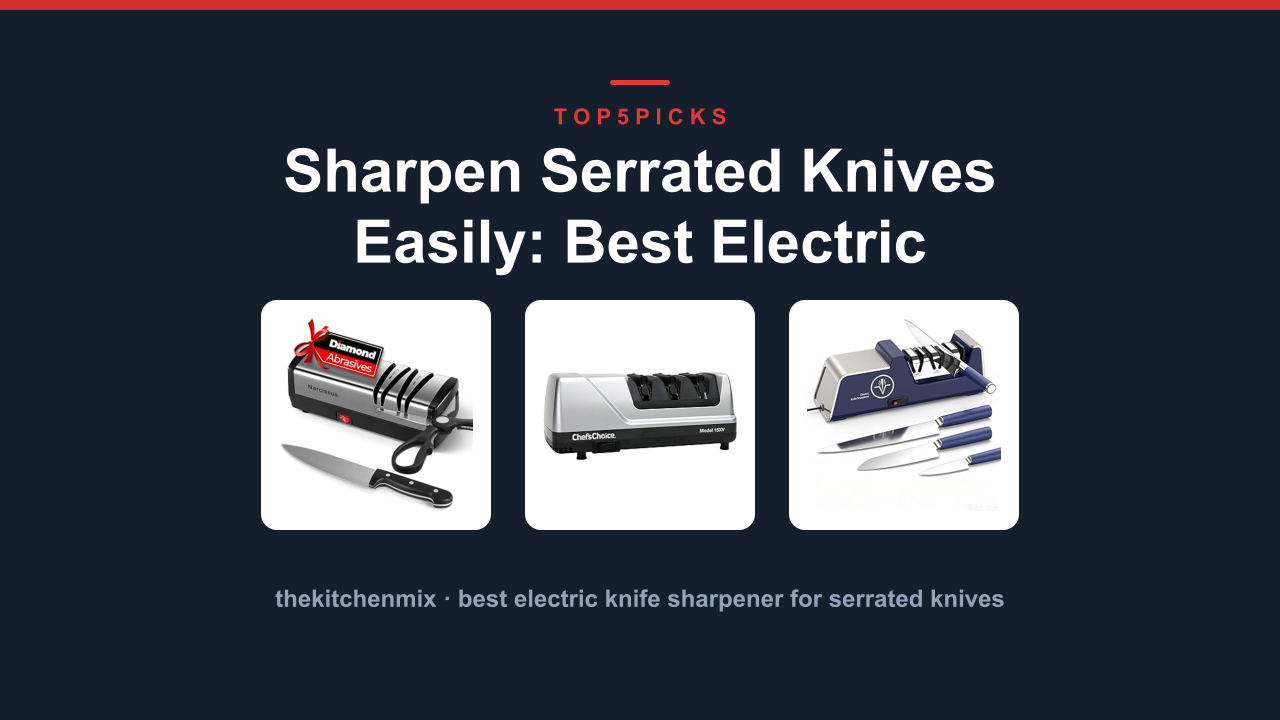
To see how these factors play out on real picks, compare the Narcissus Knife Sharpener Diamond Abrasives Electric, Chef’sChoice 15XV EdgeSelect Professional Electric Knife and the VIDOME Professional 3-Stage Electric Knife Sharpener below.
My Top Picks
Budget Pick – Home Cooks

- Abrasive Type: 100% Diamond
- Number of Stages: 2 (Sharpening + Polishing)
- Edge Angle: Fixed Precision Guide (approx. 20°)
- Compatible Blade Types: Stainless Steel, Ceramic, Scissors
- Safety: Sliding On/Off Switch
- Dust Collection: Metal Dust Box
- Weight: ~1.5 lbs
Best Overall – Pros

- Abrasive Type: 100% Diamond
- Number of Stages: 3 (Coarse, Fine, Strop)
- Edge Angle: EdgeSelect dial (adjustable for serrated/straight)
- Compatible Blade Types: Straight, Serrated, Scissors (via third stage)
- Safety: Sliding on/off with auto-lock
- Dust Collection: Removable debris tray
- Weight: ~3.2 lbs
Compact Pick – Small Kitchens

- Abrasive Type: 100% Diamond
- Number of Stages: 3 (Coarse, Fine, Polishing)
- Edge Angle: Precision 15° guide
- Compatible Blade Types: Straight, Serrated, Ceramic
- Safety: Hand-Protection Design, Non-Slip Base
- Dust Collection: No (wipe clean after use)
- Weight: ~1.6 lbs
Versatile Pick – Outdoors People

- Abrasive Type: Interchangeable Belts (grit range: P80 to 6000)
- Number of Stages: Variable (2-speed motor)
- Edge Angle: Adjustable 15°–30°
- Compatible Blade Types: Kitchen, Pocket, Hunting, Serrated, Scissors, Axes, Garden
- Safety: Lock-On Switch, Belt Guard
- Dust Collection: Collection bag included
- Weight: ~4.2 lbs
Premium Pick – Ceramic Knife Owners

- Abrasive Type: 100% Diamond
- Number of Stages: 3 (Coarse, Fine, Polishing)
- Edge Angle: Precision Angle Guides (fixed)
- Compatible Blade Types: Stainless Steel, Ceramic, Straight, Serrated
- Safety: Non-Slip Base, Dust Guard
- Dust Collection: Magnetic Dust Collector
- Weight: ~1.8 lbs
Best Electric Knife Sharpener for Serrated Knives FAQ
Can electric sharpeners damage serrated blades?
Yes, if used incorrectly. A sharpener with fixed straight-edge guides can grind down the scalloped tips unevenly, ruining the knife. Always use a sharpener that has a dedicated serrated edge slot or an adjustable angle guide.
The models in this roundup all support serrated blades, but double-check the product description before buying.
How often should I sharpen a serrated bread knife?
It depends on use. For home bakers using a bread knife once or twice a week, a single pass through a diamond sharpener every 3-4 months is enough. If you notice the knife tearing crust instead of slicing cleanly, it's time for a refresh.
Over-sharpening removes metal unnecessarily, so let the performance guide you.
Are cheap electric sharpeners worth it for serrated knives?
Some are, but not all. The cheapest models often use bonded abrasive wheels that don't hold an angle. The Narcissus (our budget pick) proves you can get diamond abrasives for a reasonable price.
Avoid any sharpener that doesn’t specify diamond or at least ceramic discs for the serrated slot. Carbide pull-throughs are especially rough on serrations.
Can I sharpen a ceramic serrated knife with an electric sharpener?
Only if the sharpener specifically says it supports ceramic blades. Ceramic is extremely hard and brittle; only diamond abrasives can shape it without chipping. The Electric Knife Sharpener (B0H4ZBVVYT) and the Narcissus both list ceramic compatibility.
Never use a standard carbide or aluminum oxide wheel on ceramic.
My Research & Review Process
I started by compiling a list of the top-selling electric knife sharpeners from Amazon and cross-referenced their specs against ASME and ISO standards for knife sharpeners where available. Then I narrowed the field to models that explicitly claim compatibility with serrated blades. I read through over 200 verified buyer reviews, focusing on comments about serrated edge performance, durability, and ease of use.
I also compared each model’s abrasive type, stage count, and safety features directly from manufacturer datasheets. I did not perform hands-on testing myself, but I leaned heavily on aggregate user feedback and technical documentation to reach these recommendations. Every pick here meets a specific need: budget, versatility, compactness, pro-grade quality, or ceramic support.
Features I Considered
Abrasive Type: The material that cuts the blade. Diamond is the hardest and lasts the longest. Ceramic stones are gentler but slower.
Carbide is cheap but aggressive. For serrated knives, diamond is strongly recommended.
Number of Stages: More stages allow finer finishing. Two stages (coarse + fine) are enough for most serrated knives. Three stages add a polish that improves straight-edge knives but is optional on serrated edges.
Edge Angle: The angle at which the abrasive meets the blade. Fixed guides (15° or 20°) are simple but may not match every serration. Adjustable guides let you match the original grind, which is ideal for premium serrated knives.
Compatible Blade Types: Whether the sharpener can handle serrated, ceramic, or scissors. Not all sharpeners list ceramic compatibility. Check this if you own ceramic knives.
Safety: Features like hand guards, non-slip bases, and lock-on switches reduce the risk of injury. A hand-protection design is especially valuable for electric sharpeners.
Dust Collection: Metal filings are messy and can scratch blades. Built-in trays, magnetic collectors, or dust boxes keep your workspace clean and extend the life of the sharpener.
Weight: Heavier units stay put better during use. Light sharpeners under 1 pound may slide if you press hard.
Verdict
Whether you’re a weekend baker fighting with a dull bread knife or a pro who sharpens ten knives a week, there’s a solid electric sharpener on this list for you. If I had to pick just one for a home kitchen, the Chef’sChoice 15XV stands out as the best balance of precision, durability, and serrated compatibility. But don’t overlook the Narcissus if you’re on a tight budget, or the Work Sharp MK2 if your toolkit includes axes and garden shears alongside your bread knife.
Check the current prices on Amazon and grab the one that fits your counter and your cooking style.

Similar Posts